Showing posts with label Tiger 131. Show all posts

Thursday, 31 May 2018

Monkeys, Tigers and an Elephant

So I'm away for a few days this week, visiting Dorset with my family and this means I'm just a short hop from the Tank Museum at Bovington. My wife gave me a 'day pass' to head off alone (while she and my daughter visited Monkey World down the road) and consequently I have spent a blissful few hours wandering around my favourite museum. I've been here dozens of times but this visit I specifically wanted to see the Tiger Collection exhibition which brings together the Museum’s Tiger I, both its King Tigers, Jagdtiger and an Elefant on loan from the US Army Ordnance Training and Heritage Center

Tiger I in front with the Elefant behind. These are massive vehicles.

The Elefant is a huge and imposing vehicle.

This was a rare opportunity to see the Elefant, a unique and somewhat odd vehicle based on the rejected Porsche Tiger chassis. Ninety-one "Porsche Tiger" chassis were converted into Ferdinand tank destroyers in early 1943 and took part in the Battle of Kursk. The surviving vehicles (about 50) were then modified based on lessons learned in the field. The improvements included a Hull mounted MG, a commanders cupola and Zimmerit anti mine past. The frontal armour was also increased and wider tracks were fitted. The changes were significant and not only made this a much better combat vehicle but also prompted the change in name to Elefant in may 1944.

The Tiger Collection

Extra armour added to the front of the Ferdinand. This and other upgrades prompted a name change to Elefant

 Rear of the Elefant

In my element.

A pre production Tiger II and Jagtiger

Post production Tiger II

Only two Elefants survived the war with one now residing in the Kubinka Tank Museum outside Moscow and the other being the US Army Ordnance Museums vehicle loaned to Bovington... so a rare treat for a UK based tread-head like me.

Friday, 31 March 2017

Tiger Friday

Just because...

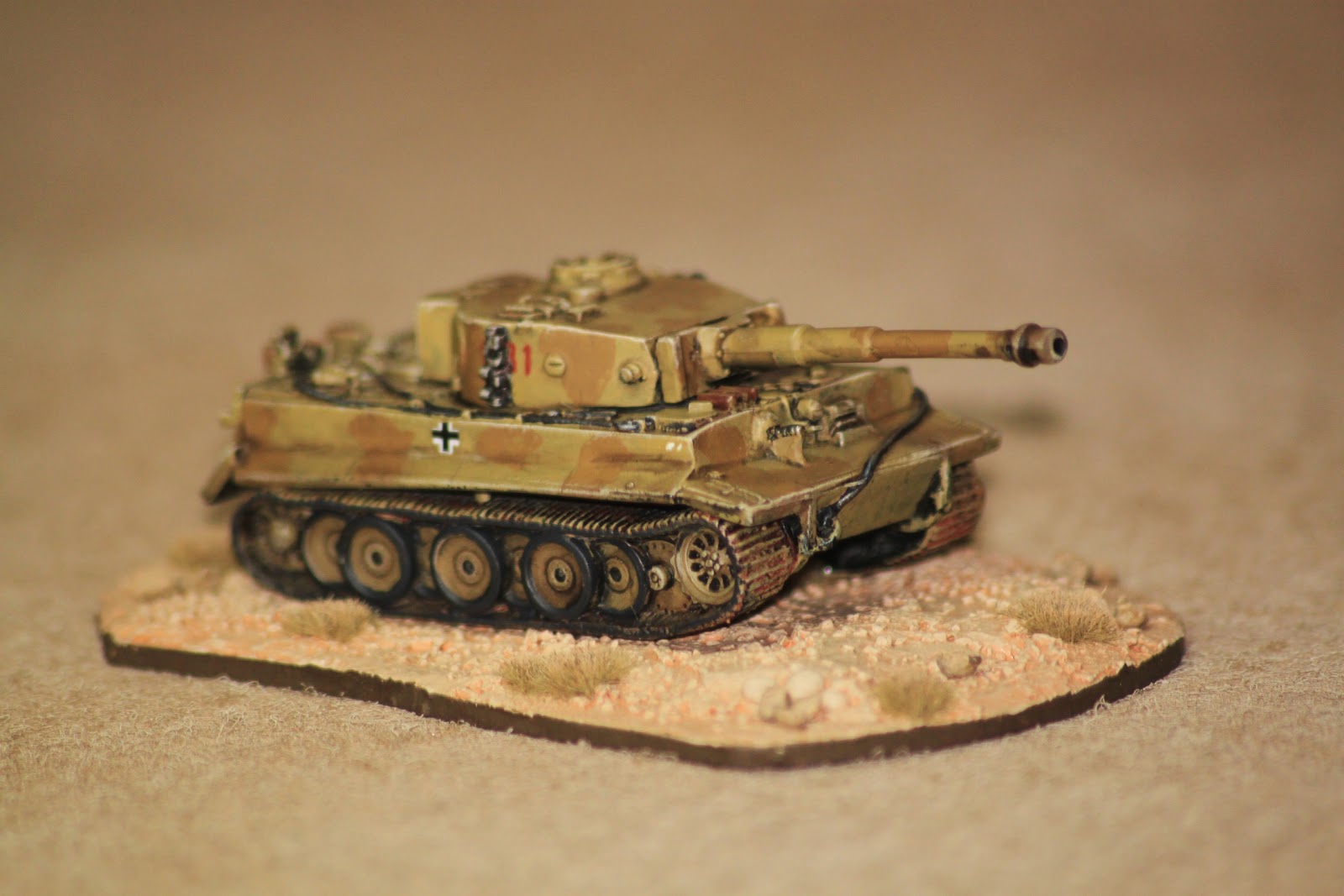
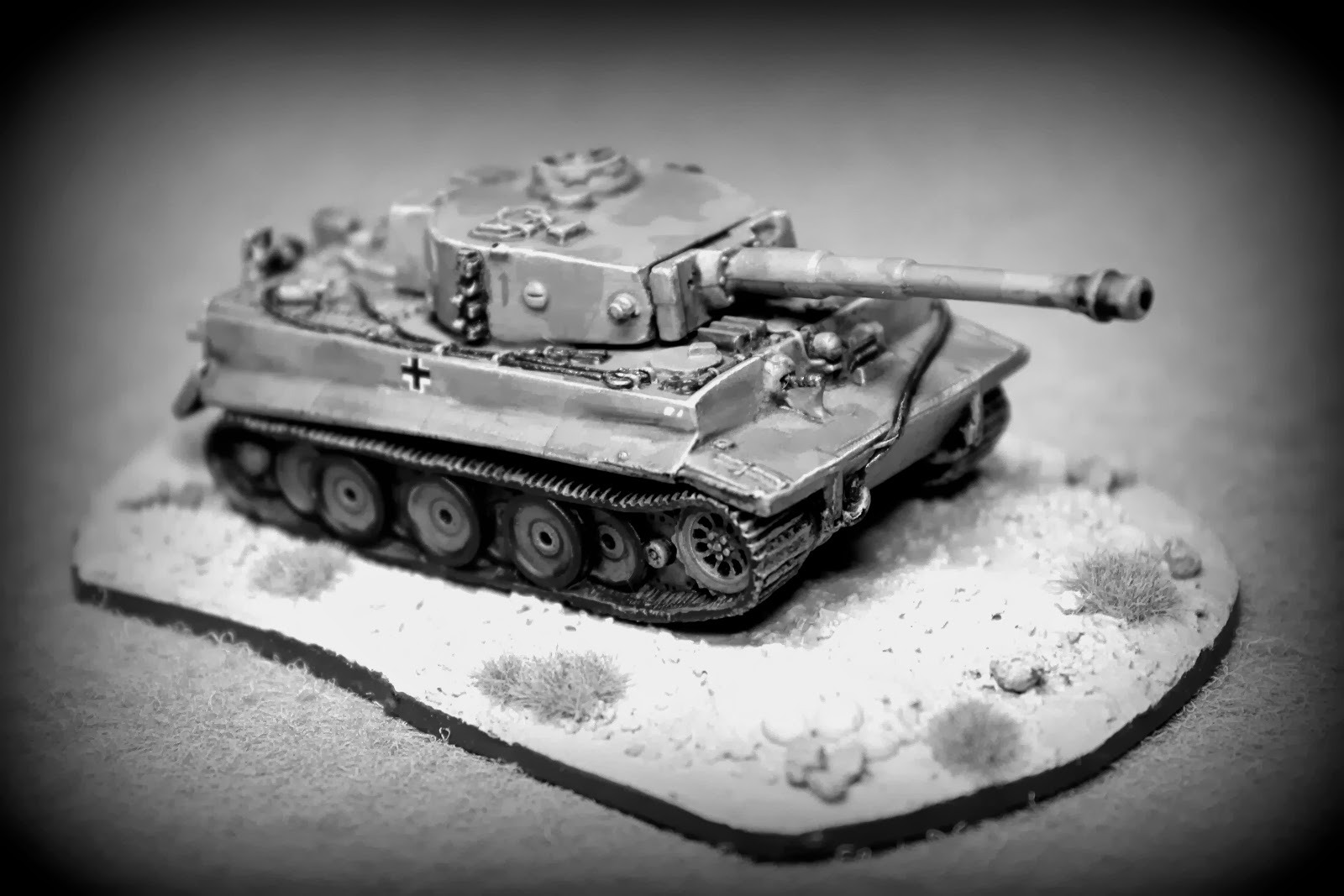
Tiger 131 at Bovington

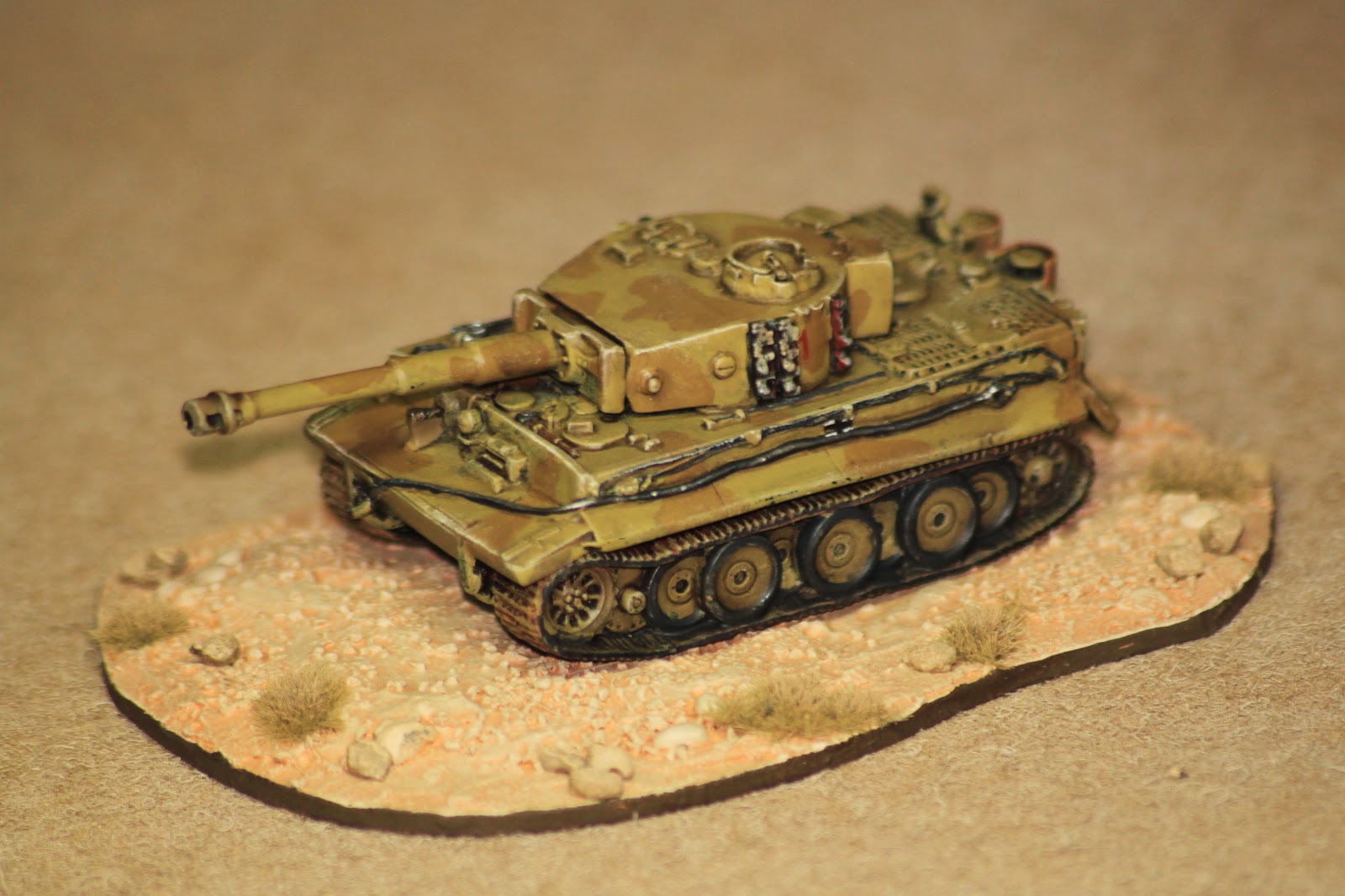
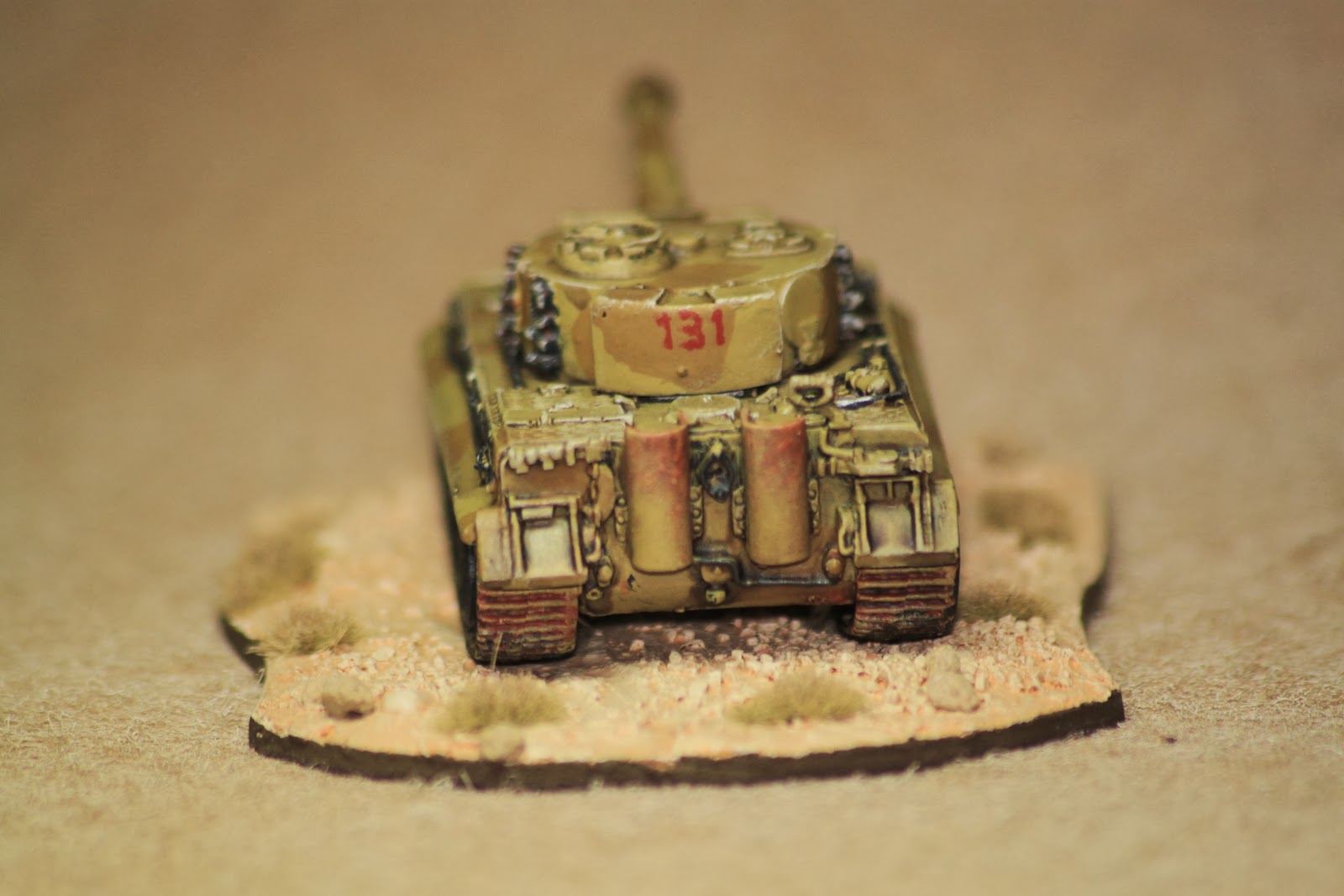
And in 15mm

And in the museum
And in 6mm (...just for Tamsin!)

Monday, 30 November 2015

Churchill III Tank in Tunisia

I have been clearing up a few old projects that have sat neglected on my desk for a while, one of which is this Churchill Tank. Its a hangover from my 15mm collection of figures that I found in storage and decided was too nice not to paint up as a display model. This will sit rather nicely next to my 15mm Tiger Tank that I painted for the Analogue Challenge a couple of years ago.


The Churchill first saw action in North Africa in 1942 when a small number were sent for evaluation purposes. These formed what became known as 'Kingforce' and saw action at 2nd Alamein. It was during this action that the Churchill's reputation for toughness was first seen, with all the tanks in the troop being hit with AT rounds multiple times for the loss of only 2 of the six tanks (one destroyed, the other immobilised).


The Churchill really came into its own when the Allied fought the DAK in the rugged terrain of Tunisia where its hill climbing ability surprised both sides. Armed with the powerful OQF 6 pdr gun the British finally had a tank that could take on the German vehicles. Indeed it was a round from a Churchill that disabled Tiger 131 - the worlds only running example of its type - now housed at the Tank Museum in Bovington.

Tuesday, 21 January 2014

Tiger 131 in Tunisia

This is a Panzerkampfwagen VI Tiger Ausf.E of the 504th German heavy tank battalion in April 1943 just before it's capture and transfer to England. Today Tiger 131 is probably the most famous exhibit in the Tank Museum at Bovington Dorset and remains (after extensive restoration work) the worlds only running example of this iconic weapon of war. When I learnt there would be a Vehicle Bonus Round in the Painting Challenge there was little doubt in my mind what I wanted to paint as my entry. 


I have had a long relationship with the real Tiger 131, from my earliest visit to the Museum aged about 7, through dozens of subseqent trips over the years until its final restoration and unveiling in March 2012 when I spent a day with other enthusiasts getting up close and personal with this incredible machine. It is a fearsome beast and when you stand next to it (and compare it to Allied tanks like the Sherman) its easy to understand why it instilled such fear in the men that had to face it. 


Despite its thick armour and huge 88mm gun the real Tiger 131 was disabled in the end by a very lucky shot fired from a 6pdr in a British Churchill tank from the 48th Royal Tank Regiment. The Solid shot ricocheted off the underside of the gun barrel and wedged itself in the turret ring, meaning the crew could not traverse their gun. Whether this is what caused the crew to abandon their vehicle is unknown but luckily for historians and military vehicle enthusiasts alike, the crew of the tank failed to set off the self destruct charges, and thus the tank fell into British hands almost entirely intact. 


Shortly after capture the tank was whisked away for evaluation and was repainted and shown off to Churchill and King George before being transferred back to England. It eventually found its way into the collection at the Tank Museum at Bovington where it has been a star attraction ever since. The tank has been repainted again several times but it wasn't until the recent restoration that the original colour scheme was rediscovered -  RAL800 (Gelbbraun) with a one third camo pattern in RAL7008 (Graugrrun) - and these are the colours I have used here.


Sunday, 28 October 2012

First 6mm Tanks off the Production Line

Following on from my earlier post about bases here's my first batch of 6mm tanks based up, labelled and varnished. A trio of Tigers to give the Allied a headache.

Tiger Platoon
Base Labels
Now that I have painted my 'test' models I'm really happy with the way these turned out. I wish I'd discovered micro armour years ago, but now I need to make up for lost time! Guess I'll be hitting the internet this evening and exercising the credit card!! 

Wednesday, 19 September 2012

Catch that Tiger : Fact or Fiction

I have just finished reading a book I bought recently on the recommendation of a friend. Now that I have finished it I may have to reconsider his recommendations in future! Catch that Tiger purports to be the true story of the capture of Tiger 131 based on the secret diaries of the man tasked with the hunt by non other than Churchill himself; Major Doug Lidderdale. Taken at face value this is an amazing story of daring do and straight out of the pages of Boys Own. I don't have a problem with a good yarn but I do have a problem if its presented as fact. So is this book fact or fiction, or a mixture of both?

What do we know for certain? Records show that Major AD Lidderdale was the officer commanding No 104 Tanks Workshop REME based near Tunis at the time of 131's capture. The first official documented connection between Lidderdale and Tiger 131 was when the 104th were tasked with supervising the recovery operation on the 7 May, over two weeks after the action in which it was abandoned by its crew. His unit went on to repair and overhaul the captured Tiger so it could be evaluated and filmed for recognition purposes. While still in North Africa the Tiger was visited by several VIP's including Churchill, General Alexander and King George VI. Lidderdale then accompanied the Tiger back to England and was the author of the initial technical report on the tank in November 1943. All of these are accepted and substantiated facts.


Major Lidderdale
The book doesn't dispute these facts but does elaborate and expand them into a tale, which if true, beggars belief and would rank as one of the great true life action stories of WWII. 

[Spoiler Alert!] The central claim is that Lidderdale was personally ordered by Churchill to bag him a tiger. He then put together a team of engineers and waited for a Tiger to get into trouble. Then the story gets wild! They watched the action at Jebel Jaffa and saw a Tiger crew clearly struggling with a jammed turret. Lidderdale then claims his makeshift team assaulted the tiger, killing its crew in the process. If this is true this is an incredible piece of missing information as the fate of the Tiger 131's crew has always remained a mystery. 

Having captured the tank his men moved it closer to the allied lines before abandoning it so it could be found by the 48 RTR the next morning! Two reasons were given for this seeming act of madness; first was that as engineers it would have been politically embarrassing for the local commanders and it was deemed prudent to let front line forces 'capture' the Tiger; second Lidderdale's secret mission from Churchill wouldn't have remained a secret for very long if the truth had come out at the time. The assumption was that the truth would be revealed at a later date but for reasons not made clear this never happened and the 'mission' was only recorded in Lidderdale's diaries and the stories he told his young son after the war.

However I - and other commentators on several WWII forums - have major problems with this book ranging from its style, its historical accuracy and the fact that it is based on as yet unpublished documentary evidence of uncertain quality. Lets look at each of these points in turn.

The Style of the book is unashamedly 'docu-drama' in format. This isn't your typical history book and in the prologue the authors make it clear that conversations presented in the story are "speculative in nature". Within just a couple of pages it is clear that what the authors call 'speculative' actually means completely fictional. Be under no doubt that most of the conversations in this book are not reconstructed based on documented letters, diaries and recollections. These are pieces of pure imagination and entertainment.

As one forum commentator stated "The book appears to be a blend of fact, over-dramatised fact, dubious fact, tongue-in-cheek fact/fiction, pure fiction and likely pure invention". Without references it is impossible to tell one type from another and so all must be treated with extreme caution. The problem is that when you take out the dubious conversational exchanges you are left with a very slender book. The obvious inference is that these were added to fill out the story. 

This leads to my second criticism of the book, its historical accuracy. There are lots of minor inaccuracies in the book that have been picked up by other reviewers. Some of this appears to be a bit nit-picking but there are some 'assumptions' and statements made in the book that just cannot be substantiated. One example was the books assertion that King George VI visited North Africa purely to visit the captured Tiger. This of course raises the profile of the tanks capture and adds weight to the idea that Major Lidderdale's 'secret mission' was a war wining moment. The truth however is that the George VI's visit to the region had been planned long before the capture of the Tiger making the authors version of events a piece of pure creative hyperbole at best and bad research at worst.


Tiger 131 after its capture


There are plenty more examples like this throughout the book where the authors appear to make assumptions and jump to conclusions that you would not expect to find in the work of more learned and respected historians. But for me the real nail in the coffin where accuracy is concerned is the fact that the book is devoid of any citations for any of the chapters. There is no bibliography, no appendices with supporting documents and no references at any point in the text. Given that we are being asked to accept this story as dramatic new evidence of a previously unknown operation then it is surely incumbent on the authors to provide some evidence. From what I can tell the only 'new' documentary evidence comes from Major Lidderdale's diaries, which have yet to be published or scrutinised by anyone other than the authors.

The authors posted an explanation of their sources on the WW2Talk forum in response to similar criticisms of mine but far from dispelling scepticism they only managed to confirm the suspicions of reviewers. "The whole thing came about through Major Lidderdale's diaries being given to us by his son, David...We also had many hours of tape recordings of David recounting the stories that were told to him by his father" [my emphasis]. I'm afraid that tall war stories alone are not a credible source on which to make such wild and frankly incredible claims.

So having now shredded this book you might be surprised to hear that I actually enjoyed reading it! If you can set aside the claim that it is non-fiction and instead read it as a historical novel its not a bad read. Its a war story straight out of the pages of Boys Own or Commando and would sit quite nicely next to the works of Bernard Cornwall and Wilbur Smith. The problem is it isn't presented as fiction and the Authors make some pretty big claims in their book and are passing it off as truth. Worse still the book has been 'reviewed' by several major newspapers and online retainers who have reinforced the idea that this book represents 'the truth'. Catch that Tiger isn't a good history book, but is a ripping good yarn. 

Friday, 27 April 2012

Haynes Tiger Manual

I've just finished reading the Haynes Tiger Tank Owners Workshop Manual. I wanted to buy this earlier but I actually got it as part of my 'Goodie Bag' at the end of Tiger Day. Now that I've finished it I have to say it was a darn good read.

Unlike a traditional Haynes manuals these books are not exclusively given over to technical drawings and instructions on how to change the smallest washer. This is much more of a history book than its cover suggests but with lots (and I mean lots) of detailed drawings and photos which show this particular vehicle in greater detail in a published work than I have ever seen before.

Much of the information presented in this book was gathered during the two periods of restoration this tank has undergone but a significant portion was also derived from the technical reports prepared by the Tank Evaluation Centre at Chobham shortly after its capture. There are also more pictures of Tiger 131 on the battlefield where it was found abandoned that I have seen published anywhere else.

All the main systems of the Tiger are discussed and evaluated in this volume from the troublesome engine to the much feared 88mm gun. But some myths are also dispelled such as the idea that the tank wasn't as agile as other tanks or that it was slow compared to its rivals. However its clear from reading this book that the unreliability of the tiger was very much a feature of how it was driven and cared for by the crew. Under battlefield conditions and in the stress of battle the Tigers systems - pushed to the edge of material and technical  tolerances for the time - could be pushed too far resulting in breakdowns and increasing the need for maintenance.

I thought I knew a lot about tank systems but after reading this volume I can say that my understanding of the Tiger has undergone a step-change in comprehension. This book is a tread-heads dream in the level of detail and insight it reveals about this iconic vehicle. It would be great if the Tank Museum could collaborate to produce similar manuals on other classic tanks in their collection (my vote would go for the Sherman or T34). Simply put if you love tanks you'll love this book and should go and buy it without delay!

Thursday, 5 April 2012

Tiger Day Slideshow

As promised here is a slideshow of all my pictures from Tiger Day at the Tank Museum in Bovington, Dorset. I had to be pretty ruthless to cut down all the pictures I shot to make the final selection you see here. I've posted some of the best pictures over the last two days with my review of Tiger Day Part 1 and Part 2 but this slideshow includes many more pictures not yet seen.


As you may have gathered from my enthusiasm for this event I was really looking forward to Tiger Day. My wonderful wife not only let me off the leash to geek-out to my hearts content she also bought me the tickets! And then - having been away for two days - she didn't bat an eyelid when I meekly told her I had a game with the Rejects all day on Sunday. She truly is the perfect wife... All Hail Mrs BigLee!

Tomorrow I'll post pictures from the D-Day Museum which Ray and I visited on the Friday before Tiger Day.

Wednesday, 4 April 2012

Tiger Day Picture Review - Part 2

Yesterday I posted pictures from the first half of Tiger Day. After our first look at the Tiger, lectures from the likes of David Willey and a slap up lunch we went out to watch the days tank display in the arena. As Premium Ticket holders we had our own roped off viewing area at the top of the slope outside the balcony area where we had lunch. The view from here was good (elevated and nobody in the way) but at nearly 100m from the tanks it just felt too far from the action... so I ducked under the rope, joined the great unwashed masses and got right down the front for a much better and closer view of the display.

Things got off to a shaky start as the first tank out, the Matilda (Infantry Tank Mark I A11), was having engine problems. Steam was poring out of the engine compartment and the two crewmen were clearly having difficulty coaxing their 76 year old tank back to life. This vehicle was manufactured in 1938 by Vickers Armstrongs Ltd. but ended its service as a target on the the Otterburn Ranges! It was subsequently recovered and restored to running order although the engine and gearbox are not original.


Next in the arena was the Matilda II (Infantry Tank Mark II A12). At the end of 1936 the War Office recognised the need for a better armed and better protected tank than the Matilda. The result was the Matilda II which went on to develop a reputation as a superb tank in the early part of the war. It carried the 2pdr gun which was considered one of the best anti-tank guns in the world at the time. However as a tank designed for infantry support the gun suffered from its inability to fire HE rounds. Due to its small size the gun could not be upgraded and once the Afrika Korps started using the 88mm gun in an anti tank role the usefulness of the Matilda II was soon reduced. This particular tank was manufactured in 1939 by the North British Locomotive Company.


The Panzer III (Sd Kfz 141/1 Panzerkampfwagen III Ausf L) was originally conceived in 1934 as the principle combat tank of the Panzer divisions. It was armed with a 50mm Gun (KwK39 L/60) that fired armour piercing projectiles. This particular vehicle was manufactured in June of 1942 by MAN in Nuremburg and was sent to Bengazi in July 1942. It was issued to the 8th Panzer Regiment and probably fought at Alam Halfa before its capture by the British.


The T34/85 was one of Russia's best tanks during the Second World War. Produced in vast numbers it was easy to build and easy to use. Its diesel engine was ideal for the cold Russian winters and in fact was so good the same engine was being used right up to the mid 60's. The original turret design accommodated two drew and a 76mm gun making it a formidable opponent. However later models were upgraded to a three man turret with an 85mm gun making this a truly war winning weapon. Later in the day I had a chance to ask David Fletcher the museums Librarian (and author of countless books on tanks and tank warfare) which tank he thought was the best of the war. He answered that it was unquestionably the T34/85.


This M4 Sherman (76mm) regularly trots round the arena at Bovington and is as agile as it was when first built which is a testament to the reliability and robustness of the M4's design. Like the T34 it was produced in vast numbers and when it first saw action was undoubtedly one of the best tanks on the battlefield. By the end of the war it was being outclassed by other tanks but the Sherman proved its worth because it was so adaptable. Variants of the Sherman abound including a range of AVRE's, the swimming DD's and the British Firefly. 


The A34 Comet was one of the best British tanks of the Second World War, unfortunately it entered service far too late to have a significant impact on the outcome of the conflict. This is the Model IB and was manufactured by Leyland Motors although I can't find a record of when it was built it was probably late 1944. The Comet entered service in the spring of 1945 and continued in use until 1960.


The first German tank build after the war was the Leopard Main Battle Tank. Gone was the obsession with armour and the gun, instead this design focused on speed as its key attribute. This tank is actually a Canadian combination of the 1A5 turret attached to a Leopard 1A3 chassis and was manufactured sometime in the 1970's by Krauss-Maffei Wegmann.


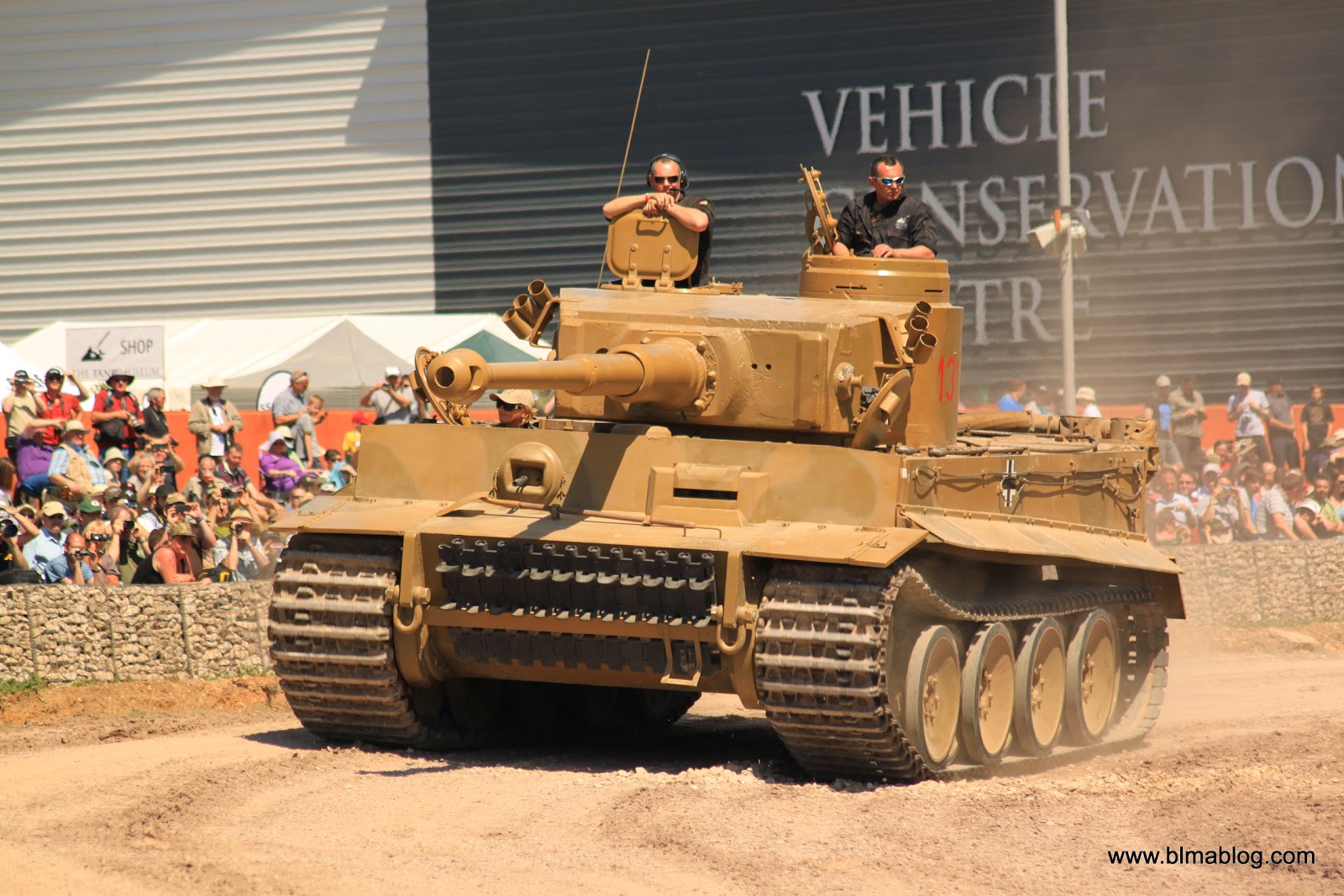
Having been teased with all these other great vehicles it was finally time for Tiger 131 to come out and wow the crowds. Even compared to modern tanks like the Leopard the Tiger looks menacing. Its squat boxy design may have been out of date by the time the tank saw service but there is no denying the psychological impact this beast had on those that faced it.


Tiger 131 was manufactured in February 1943 by Henschel and Sohn , Kassel. It was sent to Tunisia at some time between March 22nd and April 16th 1943 where it was issued to the 3rd Platoon, 1st Kompanie, Schwere Panzer Abteilung 504 of the German Army. It was captured by 48 RTR at Djebel Djaffa, Tunisia, on 21st April 1943 and was quickly shipped back to England for assessment. It was restored to running order in 1992 but the latest round of restoration has seen the tank brought back to a much more original condition (see yesterdays post for more details).


A total of 1,354 Tiger I tanks were built between July 1942 and May 1944 and the Museum’s example is the only one of the six surviving Tiger I tanks that is capable of running. As such it was an incredible privilege to see this vehicle in action and even more so to be able to get up close and personal with it.

Tomorrow I'll post a slideshow of all my photo's from this event including many that I haven't posted here yet. It could be argued that I got a little trigger happy with my two camera's but I take the view that you can never have enough photo's of tanks!

Monday, 2 April 2012

Tiger Day video of Tiger 131

As you may have gathered from my rabid mumbling of late, I was at the Tank Museum in Bovington at the weekend. The only running Tiger Tank, Tiger 131, is resident at the Museum and has recently completed its second round of restoration. I'm currently working my way through a lot of photo's but I have been able to upload a couple of videos of the Tiger which are embedded below for your viewing pleasure!

The first video was shot by my Brother-in-law Ray as the Tiger roared its way around the arena. He also captured some views of the other vehicles that took part in the display. I have several shorter videos of these and I'll upload them over the next few days.


The second video was shot by me after the public display. As a Premium ticket holder I and a few others had an excellent - and very close - view of the Tiger as it was reentered the museum buildings. I'm not sure if my video does this maneuver justice. The driver swung this 57 tonne beast round and through the doors of the museum with just inches to spare as if he were parking a mini in a garage! 


The noise of that Maybach engine has to be felt to be believed!!

Saturday, 31 March 2012

Big Picture - Tiger 131

Today is Tiger Day and I'm in Bovington visiting an old friend. Tiger 131, the only working original Tiger Tank in the world. Its just been restored (for the second time) and should be in fine running order for today's display. 

Tiger 131 on display at Tankfest in 2010
Scars on the gun barrel and mantlet from the lucky shot that jammed the turret and disabled the Tiger. 
I'm also hoping to cross paths with another old friend while I'm at the museum. Richard Smith, the museums Director is an old work college of mine. We both worked in the same office at P&O many moons ago and it was quite a surprise when I found out that he now worked at my favourite museum. We met up at Tankfest 2010 and we've crossed paths on subsequent visits so it'll be good to catch up and say hello again.

Tuesday, 8 November 2011

My Date with a Big Cat

Regular readers will know I'm a bit of a treadhead and am a big fan of the Tank Museum at Bovington in Dorset. I've been there several times and was planning on going to Tankfest in June next year. The main reason I wanted to go was the hope that I would get a chance to see the newly refurbished Tiger I tank moving under its own power.

I've had several opportunities to see this unique vehicle up close and personal but I have never yet seen it moving. Well the refurbishment is complete and the Tank Museum have scheduled a display event in March next year themed around the Tiger. Tiger Day will be on Saturday 31st March 2012 and visitors will get to see the Tiger and several other vehicles strutting their stuff in the arena around midday. However the tank Museum are also offering 100 premium tickets for an extra special experience and as its my birthday just two weeks later my lovely wife has ordered a ticket for me.


Tiger Day - Premium Ticket Holder Itinery
Breakfast with an introduction to Tiger Day from Museum Curator, David Willey.
Lecture: Saving The Tiger with Curator David Willey, Workshop Manager Mike Hayton and members of the restoration team.
Up Close with the Panzers a guided tour with the museums in-house experts. This is a chance to get even closer to the Tiger, Panzer III, Panzer IV and Panther.
Lunch with members of the restoration team.
Tiger Tank In Action The highlight of the day. Tiger 131 will make its return into the arena along with its Axis and Allied contemporaries; including Matilda II, Panzer III, T-34 and Sherman. Premium Ticket holders get to view the display in a reserved enclosure in the spectators area.
Lecture: Hitler’s Pet - Development and Capture of Tiger 131 Tank Museum Historian David Fletcher, Assistant Librarian Stuart Wheeler and Curator David Willey, will discuss the development of the Tiger tank, examining the capture and evaluation of Tiger 131.
Afternoon Tea: A final opportunity to meet and put questions to David Willey, David Fletcher and Mike Hayton, the authors of Tiger Tank, Owners Workshop Manual, published by Haynes.
Plus: All participants will be given a special Tiger Day goody bag which will include; a signed copy of the Haynes Tiger Manual, A Tiger Tank Model, A Tiger Tank T-Shirt, and a 1 year pass to The Tank Museum.


Frankly the Premium Tickets are an absolute bargain and I just hope we bought early enough to snap up one of the 100 available. My Brother-in-Law, Ray, will also be coming along so we can nerd-out to our hearts content at one of our favourite museums. To say I'm excited at the prospect is a massive understatement.

Monday, 6 December 2010

Tiger 131 Restoration Update

Tiger 131 is one of only a handful of Tiger I tanks still in existence and the Tank Museum has taken great efforts to keep it running. The Engine is currently away being restored and in the meantime the Museum has decided to investigate any damage caused by running it. This YouTube video museum curator David Willey discusses the work conducted so far.


Tiger 131 has been temporarily removed from public display and towed to the Museum’s workshop, whilst this detailed investigation work is carried out. Daily tours will enable visitors to see the tank but only on a first come first served basis.

Wednesday, 1 September 2010

Tiger 131 on DVD

Back in June I went to the Bovington Tank Museum annual Tankfest show with my brother-in-law. We had a great time and I shot several hundred pictures and posted them on this Blog. But I also treated myself to a couple of DVDs  while we were at the show and have been meaning to review them ever since.

The first DVD is "Saving the Tiger : The Story of Tiger 131" and is exclusively about the only running Tiger I Tank in the world. The story of its capture in 1943, its assessment back in England and its renovation are dealt with in detail and some of the key people involved at each stage are interviewed. In particular Peter Gudgin who's Churchill tank was knocked out by Tiger 131 and who later found himself being assigned to assess and report on the Tiger's capabilities.

In addition to the main documentary there are some extra features including the full length version of the 1943 Tiger recognition film produced for the Allied forces. I found this quite a useful insight into the training techniques employed during the war as well as highlighting some interesting recognition features of the Tiger.

The second DVD also features Tiger 131 extensively and is called "The Tiger Files".  This is a very interesting documentary lasting 72 minutes and includes archive footage and veteran interviews throughout. Whereas the first DVD looked specifically at the life of Tiger 131 this documentary looks at the full story of the tiger from drawing board to battlefield.

One of the most interesting parts of the documentary is some film shot inside the Tiger during a driving run. It shows the both the technological and technical innovation of the Tiger and some of the difficulties faced by all tank drivers on both sides of the war.  There is also some interesting interviews with various veterans that faced the Tiger in combat including Joe Ekins who is attributed with killing the German tank ace Michael Wittmann.

Tiger 131 at Tankfest 2010
Both DVDs can be bought via the Tank Museum website or in the shop at the museum itself. I think they are an excellent insight into this iconic weapon of war and well worth buying if you have an interest in WWII Armour.

Thursday, 1 July 2010

Tankfest 2010 - Pictures

It's taken a few days but I have finally been able to sort through the 770+ pictures I took at Tankfest last weekend. The following slideshow is a selection of my best pictures.


This was a fantastic weekend with a huge amount to see and do. I was lucky enough to attend both days of the show and even then I was hard pressed to see everything in the detail I wanted. This really is a premier event if you have any interest in armoured vehicles and a great place to see some historic examples running and roaring.

One example was the Valentine. I've never seen a running example of this tank before so it was a real treat to see it in the arena.

The museum has a huge variety of tanks on show including one of my personal favorites, the King Tiger.
Also at the show was Rommel's staff car from North Africa. This is privately owned but was brought to Tankfest and put on display with Tiger 131.

The Tiger is currently undergoing renovation so was not running at the show. This was a great pity but hopefully the work being carried out now will ensure this historically significant tank continues to run for many more years to come.

Sunday, 1 November 2009

Tank Times

The Bovington Tank Museum newsletter Tank Times has just been put on their website as a pdf document. It's only 4 pages but very interesting if you've ever been to the museum. Inside there are details of the museums current campaigns and fundraising activities, including the Tiger 131 appeal. Bovingtons Tiger 1 is the only working example left in the world, and only one of six still in existence. It was renovated in 2004 but now needs additional work on the final drive and cooling system. You can find out more about this appeal here. The new wing opened this year and visitor numbers have sored, despite the tough economic times. I was lucky enough to visit the new exhibition 'The Tank Story' shortly after it opened and heartily recommend it to anyone interested in military history. Here's a short advert that might tempt you further....