Showing posts with label Ral Partha. Show all posts

Monday, 6 January 2020

Ral Partha Sorceress

As previously mentioned I'm going to be playing a lot of Frostgrave with the Padawan this year and have largely been able to repurpose my old Dungeons and Dragons figures for use in this setting. However, she did note that my collection didn't include many (or indeed any) female wizard figures. I did wonder if this was a sad reflection on the nature of figure design in the 80's and 90's (ie lots of chainmail bikini's and little else) but looking back through old magazines I see plenty of female figures that I could have bought. So I guess this 'gap' in my collection says more about me than it does about the availability of figures when I was buying them!
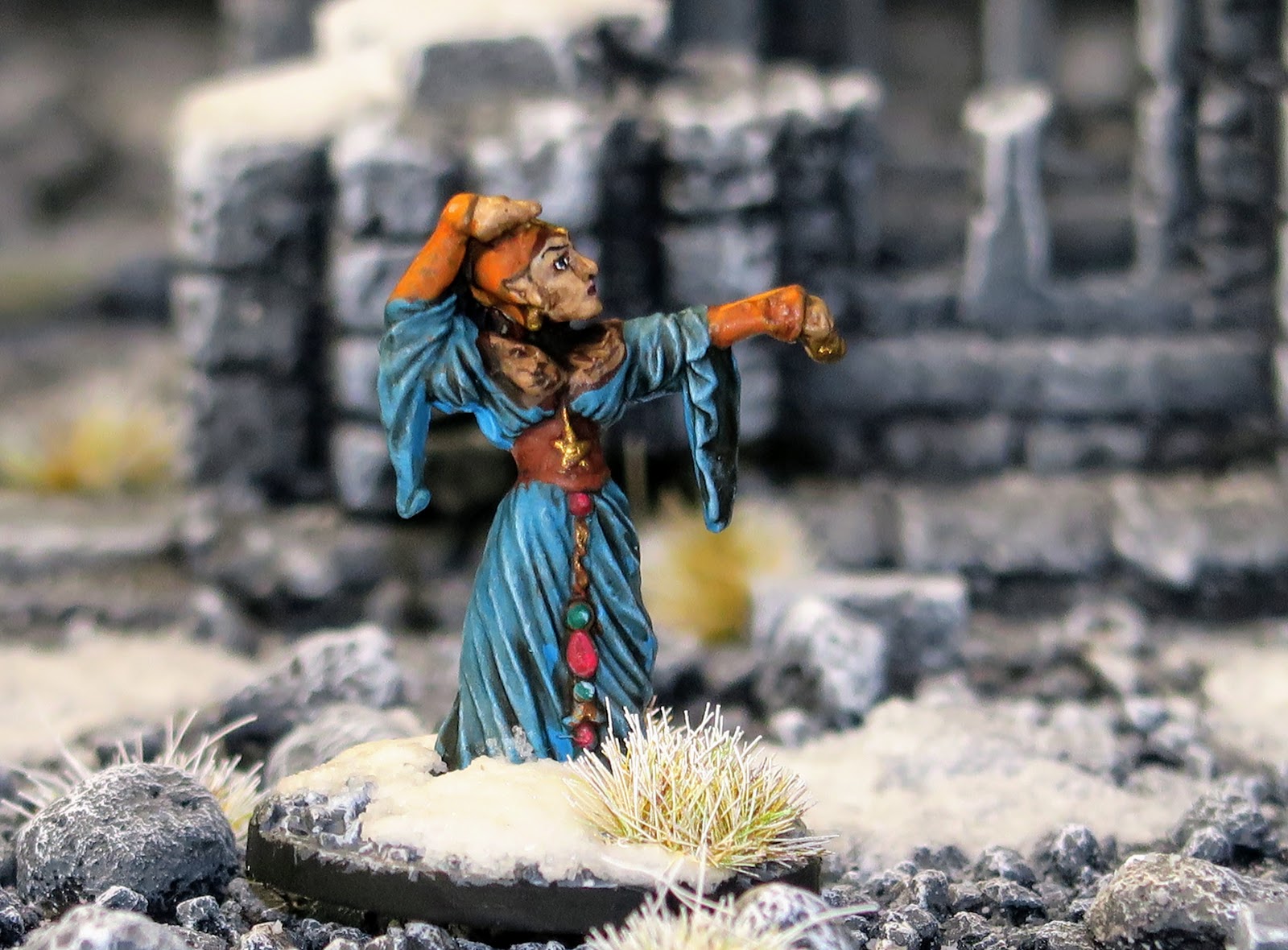


Feeling a little stung by this realisation I decided to see if I could find some suitable female figures online and in particular on eBay (a wonderful source of old mini's) to correct the imbalance. I eventually bought several models, some of which will be featuring later in the challenge. This female sorceress, however, was not only the oldest model in the batch it was also one of the best looking sculpts. The base stamp shows this to be a 1977 Ral Partha figure and when stood next to other '28mm' figures its a perfect example of scale creep over the decades. This magical female is best described as slender, but despite this, there is plenty of detail to be found in the design making it fun to paint.


Given that I plan on using this for Frostgrave, I decided the character needed some additional warm weather clothing and so I added a fur stole across her shoulders. I was going to sculpt this using greenstuff but inexplicably I couldn't find it (must have been lost or misplaced when I moved into my Operations Room). In the end, I used a product I have not used before, Plastic Putty by Vallejo. It's not strictly designed for sculpting but for little details like this, it worked perfectly. I applied a thin layer across the shoulders of the figure and as it dried over the course of half an hour I shaped it with a small brush.


Now if my math is correct this little figure will net me quite a few points. A base 5 for the figure, 30 points for completing the location and a further 20 bonus points because it's a 1970's miniature. I'll leave it's to the umpire to decide if I have also earned the additional ten points for the backstory on how I acquired this figure. So this could net me up to 65 points, and all because my choice of figures from my early days of gaming was a little bit misogynistic! 

Thursday, 28 June 2012

A Ral Partha Giant by Tom Meier

This Ral Partha Hill Giant dates from 1977 and has spent a long time languishing on my desk in a semi painted state. Its an early Ral Partha figure by Tom Meier and was one of three Hill Giants that were available back when Ral Partha were still a basement business, this one being Version 1 (Reference ES/01-052 v1). Because this is an early Tom Meier Ral Partha figure it was part of its 25mm range ('Heroic' scale or 28mm hadn't appeared yet) but being a Giant it actually stands 50mm from Base to Eye level or 57mm to the top of its head. 


I'm not sure how this Hill Giant came into my possession but it had clearly had a hard life prior to its arrival in my hands. It had been painted and based by another painter but the quality of the finish was poor to say the least. It had taken quite a battering in its prior life and what paint remained on the figure was chipped and worn leaving the model in a very sorry state. It wasn't therefore a hard decision to strip the old paint off and give this model a new lease of life. 

I stripped the model by soaking it in a simple solution of washing-up liquid and warm water. I then gave it a gentle scrub with a soft brush. This process was repeated several more times until all the old paint had been removed. I them made sure the figure was thoroughly dry before priming the whole figure - including the underside of the base - to stop any potential damage from Lead Rot. Because this is an old figure the lead content is much higher than modern figures and therefore much more prone to corrosion. Painting the figure seals the surface and is a very effective means of conservation. 

During the clean up process I not only removed the old paint but also broke off a large clay base that had been added by the previous owner. The clay came off quite easily, pretty much in one big chunk. With the metal base cleaned the makers mark was revealed as Ral Partha 1977. I would have been 7 or 8 at the time this venerable old man first hit the shelves and he therefore pre-dates my introduction to D&D and a lifetime of gaming! 

Although this miniature started life as a Hill Giant I decided that I wanted to paint it as a Frost Giant instead. At the time when I acquired the figure I was writing a Dungeons and Dragons campaign to be set in the Frozen North of my Campaign Setting, The Isles of Ethos. A benign Frost Giant was required and this model fitted the role perfectly. But that campaign never came to fruition and the Giant remained semi-painted for a long long time.


In the intervening time I have painted a lot of 15mm WWII figures but now and again I feel the need to paint something completely different just to add a little variety to my art. I've come to a temporary halt on my Panzergrenadier project and was casting around for something quick to paint just for fun when I remembered this model.

Its a beautiful sculpt with lots of character and was really fun to paint. I don't know if this will ever see the surface of a games table but for now its taking pride of place in my rather small display cabinet.

Monday, 21 December 2009

Ral Partha Giant

I found this old model recently and decided to give it a makeover. I'm not sure where I got it from but it had been painted and based by another painter. Unfortunately the quality of the paint job was, well, poor (I'm being charitable, it is Christmas after all). The model also looked like it hadn't been varnished because pretty much every surface was chipped and bare metal showed through in several places. So I decided to strip it back to a clean surface and start over. So far I've only got as far as priming it but needless to say I'll post pictures of my progress when I finish. I made an interesting discovery while preparing the model. It had been based using some sort of clay material and I wanted to put it on a much larger plastic base. So I chipped some of the clay off and the last slab, covering the bottom of the base, came off in one chunk... revealing the makers date of 1977! This old fella pre-dates my introduction to D&D. I would have been 7 or 8 at the time this first hit the shelves.

I'll be painting him with reverence and when finished he'll get a special place for display. If anyone can identify the model further (Who sculpted it? Did it have a name?) I'd appreciate any information you can supply.

Tuesday, 3 March 2009

Scale Creep Pt 2 - Examples

Part one of this series looked at the definition of scale and briefly discussed some of the more popular scales in use amongst wargamers and roleplayers (and by extension Miniatures Painters). This post will attempt to give some examples of scale creep and explain why and how it has come about.

In the early 1970's the proliferation of manufacturers and sculptors of 'lead' miniatures began to result in lots of variation in scales. Although many 'game' pieces were supposed to be 28mm much variation resulted from the different ways manufacturers measured scale. Some measured 28mm from the bottom of the base to the top of the head, while others measured from the base of the foot to eye level.* For that reason it soon became apparent that miniatures advertised as "28mm" could easily be over 30mm tall. Here is an example of two supposedly "28mm" human miniatures. It is clear that the miniature on the left (Perry) is genuinely 28mm from foot to eye while the miniature on the right (Reaper) is more like 35mm!

There are two explanations for this upwards trend in figure size. One is technical and the other is to do with marketing... bare with me here. The technical issue is that a larger model is more suited to highly detailed sculpts. Just as a 15mm model will have more detail than a 6mm model the same principle applies to the difference between a 28mm and 35mm model. Here's an example:


The thief on the left is a 1992 Ral Partha miniature and is 28mm from foot to eye level. The picture on the right is a Games Workshop Barbarian made in 2002 and measuring a whopping 34mm. By increasing the size of the model by a mere 6mm the surface area of the miniature is increased by 25%. (I'm rubbish at maths so this figure is courtesy of my 'genius' daughter). It is easy to see how this can allow more detail to be put into the model.

The second reason for increasing size is that it makes painting easier. The Games Workshop style of slightly exaggerated figures means that models are bulkier with slightly over-sized heads and hands. They seem to look better from a distance such as on the games table. Some commentators have even suggested that this new 'Heroic Scale' version of 28mm was a deliberate marketing decision by companies like Games Workshop because their customer base was 10-14 years old's. The reasoning seems to have been that this demographic, starting in the hobby with no prior painting experience, would find this scale easier to paint. Recent models from the likes of the Perry twins are more proportional and 'realistic' but do seem very 'weedy' when compared to 'heroic' scale models.

Tomorrow I will look at the effects scale creep has on painting techniques.


*This is the method that I use to define the size of a miniature.

Friday, 23 January 2009

Seductress Dragon & Pets

This is an old Ral Partha model that I picked up in a shop in Guildford while visiting a good friend of mine. I painted this for a recent D&D game to represent a deceitful seductress and demoness by the name of Lady Van'Dathe. The original model came with wings but this didn't fit with my concept for the character so I left them off. The model stands about 70mm tall from base to eye level. Lady Van'Dathe was accompanied by her 'pets', a trio of Heresy Miniatures Giant Slugs sculpted by Paul Muller. All the models were varnished using GW Hardcoat for durability.

Wednesday, 21 January 2009

Unpainted Lead

Now that I have finished painting my Buccaneer Captain I have been giving serious thought to what to do next. The only problem is I have far too much choice. Like many gamers I have a quite 'substantial' collection of unpainted miniatures gathering dust. To be fair I had a good clear out a few years ago but the collection still remains larger than my ability to finish painting. It has been said that if a gamer were to paint his last model he would probably expire on the spot. I'm not sure if that is true but my wife would probably want me checked out by the Doc to see if I was OK.

So what have I got lurking in my model box that begs attention? For a start I have two half finished projects that make me feel guilty whenever I look at them. The first is a Reaper Cavern Worm by Jason Wiebe. The second is the Salute 04 free figure, Hannibal, sculpted by Mark Sims. Both projects didn't get past base coating because other jobs (for upcoming games) took precedence.

Possibly my biggest crime of neglect goes to a set of Games Workshop LoTR figures that includes Tom Bombadil and Goldberry. I bought the Barrow Downs box set just for these two models and then didn't paint them. Also in my model box are a number of resin scenery and buildings, including some excellent neanderthal huts by Hovels Ltd. I also have a few barricades by Ainsty that I should have painted ages ago. Then there are the Amazon Warriors that I bought from the bring-and-buy stall at Salute, a Ral Partha Hydra given by a friend and a collection of early Space Marine models that I got at a local Boot Sale.

It's a sad litany of neglect and overspending that could go on and on. And I'd wager my best brushes that I'm not the only gamer out there with a similar story. Indeed this very subject was recently discussed on the blog A Year of Frugal Gaming. So, what am I going to do about this? For a start I'm going to ask myself some serious questions before buying new models. That's not to say I won't buy any (get real folks!) but I will try to buy quality rather than quantity. And I must also try to paint more miniatures this year and reduce that lead mountain... even if it is deleterious to my health.