Showing posts with label Zvezda. Show all posts

Wednesday, 24 February 2021

AHPC XI - Week Nine - Printed PAK's to a Mouse that Roared

Its been a mixed but productive week for me, with several painting projects coming to fruition and a series of videos on my Channel queued up and ready (after a LOT of editing). I've been making an effort to focus my painting on miniatures that have sat neglected for a long time. Often these are models that were primed and ready for challenge XIII or IX two or three years ago! I really ought to do a video on procrastination!

3D printed 8.8cm Pak 43/41

A couple of weeks ago I panted up some trenches from Ironclad Miniatures but the gun emplacements were missing their ordinance. I'd ordered some 3D printed models but they hadn't arrived so I finished the trenches knowing I'd be revisiting them in due course. The printed guns arrived last week and here they are. Two 8.8cm Pak 43/41 guns from Butlers Printed Miniatures. I've never bought any 3D prints before so I was interested to give these a go and I'm pretty impressed with them. The printing layers can still be seen in some areas and the models needed a lot of cleaning up when they arrived, but they were half the price of a plastic or metal equivalent. I bought these primarily as 'terrain', simply to put them into the trenches so my British Para's could attempt to knock them out. So while the quality isn't as good as a metal model, I'm pretty pleased with them as terrain, especially at the price I paid.


When you read accounts of the battle in Northern Franch and tankers describe being attacked by 88's, these are probably the weapon they are talking about. Krupp designed this weapon in direct competition with the Rheinmetall Flak41, and they produced a very successful weapon indeed. The Krupp gun was the most powerful anti-tank gun in service with the Wehrmacht and a modified version (the KwK 43) became the main gun of the Tiger II tank.


Its relatively low profile meant it was ideal as an ambush weapon and the wheeled version (the original had a cruciform mount) meant it could be moved quickly from location to location. I once talked to a British veteran who served in Normandy as the driver of a Cromwell tank, and he described a hit from a Pak43 which split the engine block of his tank clean in two. Fortunately, he and all his crew were able to escape, but the tank had to be abandoned.

Kights Solar - Paladin with Elemental Sword

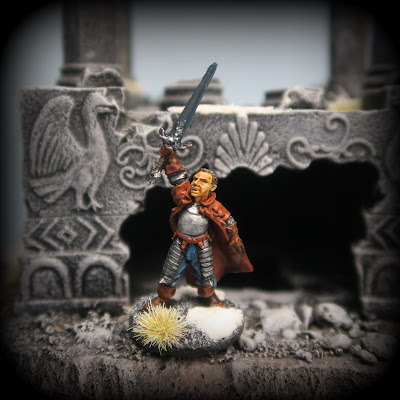
At least I have reached the Third Level of the Chambers of Challenge. It's taken a while to reach it but every stage has been interesting and fun so I'm not complaining. Now we get to the most challenging rooms and I'm starting off with my entry for the Kights Solar. The brief says "A chamber for painting Kights of all kinds, and their knightly deeds, love's, pastimes and quests". Hmm, the ultimate expression of Kightly piety in the fantasy world is the Paladin and I had the perfect model for that. This warrior venutred into the frozen city of Felstad in search of a fabled elemental sword. He has been searching for it in lost scolls and ancient tombes for many years and now he has found it. His Quest is over...but first he must make it out of the city alive.


This is a 28mm Ral Partha Figure from their Pathfinder range and looks particularly heroic. The casting is wonderfully clean and the face was so well sculpted it was a joy to paint. Once again I have based it for use in my Frostgrave games (really must venture back there soon).


The Mouse that Roared - Panzer VIII 'Maus'

I'm aware that I have painted a lot of fantasy figures this Challenge, so I thought I would paint something historical for a change...well sort of. The Panzer VIII was only at the design and trials phase in late 1944 when the Soviets overrun the German testing grounds and of the five ordered, only two hulls and one turret were completed. Had it been completed it would have been the largest tank in service.


At 33 ft long, and 188 metric tons the 'Maus' was absolutely huge, dwarfing all other German and allied tanks. Its main armament was the Krupp-designed 128 mm KwK 44 L/55 gun with a coaxial 75 mm KwK 44 L/36.5 gun. The main gun was powerful enough to destroy all Allied armoured fighting vehicles then in service, some at ranges exceeding 11,500 ft. But like all grandiouse vanity projects, it was plagued with practical problems, not least finding an engine powerful enough to drive the tank. At a time when the Wermacht was desperately short of regular tanks, this hugely resources heavy development project could only have been dreamed up in the minds of a political system that couldn't comprehend defeat, let alone appreciate the practical needs of fighting a war on two fronts.


Of the two hulls built, only one survived the war and was married up with the surviving Turret and taken back to Russian for evaluation. After testing it was taken to the Kubinka Tank Museum for storage, where it remains on display.


Nearly There

Progress towards my target is steady and I should hit it next week if all goes to plan. My points trajectory isn't going to blow anyone's socks off but its been the right pace for me at a very busy time of the year and I'm enjoying it immensely.



Next week I hope to have some more British Para's finished and a few more odds and ends that will take me to my target.

Wednesday, 9 January 2019

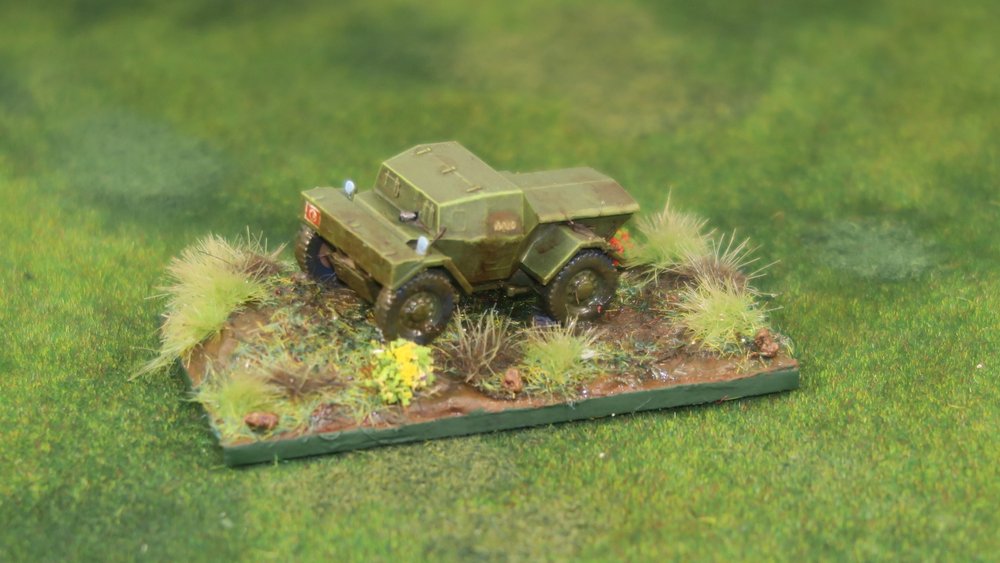
Mark I 'Dingo' Scout Car

The 'Dongo' was a small two man scout car first conceived in 1938 as the British army started to embrace the idea of mobile armored divisions. Several concept designs were produced, all roughly similar, but it was the BSA prototype that was eventually selected, although they kept the 'Dingo' designation that Alvis had given their rejected prototype. Initially armour was only designed to resists infantry rifle fire but on the army's insistence the frontal armour was increased to 30mm. However it was the vehicles low profile and speed, even cross country, that was its main defense. 


The Dingo had an extremely long range and relatively tight turning circle making it ideal in its role as a scout or recon vehicle. The transmission consisted of a pre-selector gearbox, with five forward gears and five reverse gears, allowing steering with all four wheels. The system was very flexible but difficult to master and later models just has front wheel steering. 


The car was usually armed with a removable cal. 0.303 (7.7 mm) Bren gun, with a dozen spare magazines. However this could be swapped for a heavier Boys antitank rifle (0.55 in/14 mm).


The Dingo saw service throughout the war and continued in the British Army well into the 50's and 60's and in overseas forces even into the 1970's. 

The model is from Zvezda and is a relatively simple to construct and paint. The model clips together although I used glue to strengthen the joins and fill any gaps. In the end I spent more time working on the base than on the vehicle. I particularity focused on making the ground look wet and muddy, to emphasis ths vehicles exceptional off road ability. I did this using a Vallejo texture paint, plenty of varied vegetation and by using a mix of varnishes. I used a brush on Dullcoat (Testors) for 'dry' areas which gives a perfectly flat finish. For the wet areas I used Windsor and Newton Gloss because it gives a really nice shiny finish. 

Sunday, 26 August 2018

Queen of the Desert - Matilda II

My latest painting project is a pair of Matilda II's, which (when first introduced) were probably one of the best tanks in the British arsenal. Initially designated the A12 the Matilda II was naturally a development of the Matilda I which first saw service in 1938. As seems to be the usual way with tank development the building of a first generation tank inevitably throws up a load of design problems that lead to the second generation on the drawing board almost before the first had even entered service. This was true for the Matilda and by September 1939 the first Mk II's were entering service (only two machines, but with more entering service each month). By the end of its production run over 3000 Matilda II's had been built.

Source: the-blueprints.com
Both Matilda were developed in line with British military thinking at that time which saw the need for three types of tanks; Heavy Tanks; Cruiser Tanks; and Infantry Tanks. The Matilda's were of the latter type which meant they were designed to be heavily armoured but slow moving so they could support the infantry. By the Matilda II a key design specification was that it had to be able to be impervious to the main AT gun at that time, the 37mm. Consequently the armour on the A12 was incredibly thick (up to 78mm on the front) and could wade into battle impervious to almost anything the enemy could throw at it. Indeed early in WWII the 7th RTR attacked the 7th Panzer group near Arras in France and did so much damage - with so little loss to themselves - that panicked shock-waves rippled throughout the German high command. It has been argued that this action contributed towards the German decision to halt the advance towards Dunkirk and bought time for the evacuation. I have also heard it said that Hitlers personal obsessive intervention in tank design (for ever larger tanks with even bigger guns) stemmed, at least in part, from this moment.

The tank may have been slow (top speed was about 15mph) but the Italians found it virtually impossible to disable let alone destroy. Initial Matilda II's were powered by twin diesel AEC 87hp engines although later models retained the double engine configuration but used the more powerful Leyland diesel engines with 95hp each. This double engine sounds complicated but the Matilda II was easy to maintain and run and was generally considered by tank crews to be very reliable.

Matilda II's of 7 RTR during
Operation Compass - Dec 1940
By 1940 more Matilda II's were entering service and in North Africa the 7th Armoured Division put them to good use against the Italians in Operation Compass. They were able to smash their way into the fortified camps the Italian Army had built after invading Egypt and pretty soon proved themselves superior to anything the Italians could throw at them. The reputation of the Matilda II took a bit of a battering in later years as it was slowly superseded by newer, larger and better armed German vehicles but in 1939/40 it could arguable be described as cutting edge tank design.

My Matilda II's are hard plastic Zvezda models and clip together very easily. I added a dab of glue to strengthen the models and then cleaned them before base coating. I have opted to paint them in the Caunter camouflage scheme although its worth saying that there is some debate about the colour I have used. The IWM and Bovington Matilda's are painted in a Grey/Blue colour scheme but it seems they got the colour wrong and the blue should actually be a light grey. The problem is I like the colour scheme, so I have decided to stick with the colour scheme we are familiar seeing.

The Caunter camouflage can just about be seen in this picture of a Matilda II captured by the Italians in January 1941 (Source: Public Domain)

My two Matilda II tanks with the Caunter camouflage pattern.


July and August is always a lean period for gaming and painting because of family holidays and a wealth of other commitments like weddings and birthday parties. But for the most part things are settling back to normal and its high time I made an effort to get my painting, gaming and blogging back on track. 

Friday, 4 May 2018

Tanks begin to roll in

After my recent play test of the new What a Tanker! rules I decided I wanted to play more of this game and that I want run a game at Reject HQ as soon as possible. I have a random selection of 15mm tanks left over from when I sold most of my collection a few years ago. I have enough 1944/Normandy tanks and terrain to play games in this period but in the end I decided the call of the Western Desert was too strong. Despite amassing a large 6mm collection for this theatre the chance to repaint some early desert war tanks in 15mm was just too much of a temptation. Nearly a hundred quid and 16 tanks later I have ordered a range of British and Italian armour to play What a Tanker! in the setting of Operation Compass, late 1940 early 1941. 


The first batch of models arrived yesterday, with some M13/40's from Old Glory. I haven't bought from this company before and was pleasantly surprised at the quality of the castings and the speed of delivery. Apart from some minor warping of the tank deck (which won't show once painted) the casting is perfect and quite detailed. I'm  looking forward to slapping some paint on these.

I've also bought some Battlefront M11/39's and L6/40's to get me started with the Italians. For the British I have managed to get A9 & A10 Cruisers from PSC, some Valentine II's (also from Old Glory) and a Matilda II from Zvezda. An eclectic mix that will arrive over the next few days. I'm like a kid in a candy store and my enthusiasm is evidenced in the rolling of my wife's eyes whenever the post arrives!