While I was away on Holiday a few weeks ago I visited the Fleet Air Arm Museum in Yoevil. I've never been to this museum before, and while it's not as large as the collection at Hendon (pictures here and here), I did find it very interesting and enjoyable to explore. There were lots of detailed models and information available for viewers as well as plenty of informative videos throughout the exhibition.
The museum charts the birth of the Fleet Air Arm from early experiments with ship launched aircraft right up to the modern carrier ships of today. The Carrier Experience was particularly interesting with visitors taking a simulated ride on a Wessex Helicopter out to a Carrier ship. When visitors exit the Helicopter they step out onto the flight deck of a carrier (simulated very well inside a huge hanger building). Simulated takeoffs and landings using static display aircraft and huge projection screens give a really good sense of the noise and frenetic activity of the flight deck.
Friday, 6 May 2011

Wednesday, 4 May 2011
The Keep Military Museum
Yet another slideshow of pictures I took while on Holiday a couple of weeks ago. This time the pictures are from The Keep Military Museum in Dorchester, Dorset. I've been to Dorchester several times before but never visited this museum and am glad I got the opportunity this time around. The collection is spread across four floors and is dedicated to the Devonshire and Dorset Regiments, The Dorset Yeomanry, The Queen's Own Dorset Yeomanry, The Dorset Militia, The Royal Devon Yeomanry and the 94 Field Regiment Royal Artillery.
The Keep was built as the gatehouse for the Depot Barracks of the Dorsetshire Regiment and as the County Armoury. Completed in 1879 the Depot Barracks were the administrative centre for the Dorsetshire Regiment and its centre for recruitment and training. The Depot carried out this function between 1879 and 1958. During World War Two the barracks were used by the 701st Ordnance Light Maintenance Company and the 1st Quartermaster Company of the American Armed Forces. (Source Museum Website)
The collections are diverse and interesting with displays being arranged in such a way that each cabinet tells a story of an individual, battle or campaign. Many of the items displayed are very interesting and rare. One item that stood out not only for its size but also for its historical significance was Hitlers Desk. This was taken from the Reich Chancellery by the Russians and later passed into the hands of Major General Bishop of the Dorsetshire Regiment in 1945. The provenance of the desk was confirmed when the drawers were found to still contain the Fuhrers personal writing paper and his 1943 Christmas card!
Other items on display are of a much more humble nature but are no less significant for the stories that have to tell. There are thousands of medals on the upper floor of the museum with smaller collections (includeing several VC's) throughout the collection. This is a relatively small museum but a fascinating and well presented one that is well worth a visit if you get an opportunity.
The Keep was built as the gatehouse for the Depot Barracks of the Dorsetshire Regiment and as the County Armoury. Completed in 1879 the Depot Barracks were the administrative centre for the Dorsetshire Regiment and its centre for recruitment and training. The Depot carried out this function between 1879 and 1958. During World War Two the barracks were used by the 701st Ordnance Light Maintenance Company and the 1st Quartermaster Company of the American Armed Forces. (Source Museum Website)
The collections are diverse and interesting with displays being arranged in such a way that each cabinet tells a story of an individual, battle or campaign. Many of the items displayed are very interesting and rare. One item that stood out not only for its size but also for its historical significance was Hitlers Desk. This was taken from the Reich Chancellery by the Russians and later passed into the hands of Major General Bishop of the Dorsetshire Regiment in 1945. The provenance of the desk was confirmed when the drawers were found to still contain the Fuhrers personal writing paper and his 1943 Christmas card!
Other items on display are of a much more humble nature but are no less significant for the stories that have to tell. There are thousands of medals on the upper floor of the museum with smaller collections (includeing several VC's) throughout the collection. This is a relatively small museum but a fascinating and well presented one that is well worth a visit if you get an opportunity.
Monday, 2 May 2011
Destroyed Stug Objective Marker

One thing I wanted to do was add some visible battle damage as well as using the paint job to show its knocked out status clearly on the game table. I used white Milliput Putty to mold some detailing in the form of a blown bulkhead and then distressed the Shurzen plates with bullet holes, scrapes and twisted metal.


Sunday, 1 May 2011
Big Picture : Splinter Mask
This medieval looking piece of equipment actually dates from WWI and was issued to early tank crew. The mask was designed to protect the face and eyes from flying splinters of metal dislodged from the inside of armour plate when hit on the outside by bullets or shells. The kinetic energy of an incoming round could even send streams of molten metal shooting off the inside of the armour, making the interior of the tank an even more hellish place to fight than it already was. I can't think of a more graphic artifact that sums up the brutal nature of early tank warfare more than this.
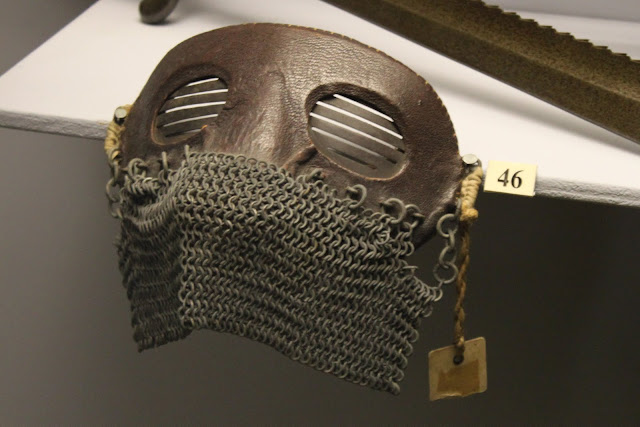

This example is on display in the Keep Military Museum in Dorchester. I'll be posting more pictures from this museum on Wednesday.
Subscribe to:
Posts (Atom)