Wednesday, 19 February 2014

40 Years of Adventure

My job has been exceptionally busy over the last few weeks and as a result I have had very little opportunity to write anything for the Blog or paint anything for the Analogue Challenge. I'm still very busy but I am slowly getting to grips with my suddenly increased workload and hopefully things will return to some sort of equilibrium over the next couple of weeks. I'm hoping to have a new entry for the Challenge by the end of the week (I've already submitted my Casualty bonus entry) and I am trying to catch up on the huge back load of Blog Posts that I haven't had a chance to read. I'll get there eventually, but it may take a couple of weeks! 


D&D Red Box - My Introduction to Adventure
One event that almost passed me by unnoticed was the 40th anniversary of the Dungeons and Dragons roleplaying game. My own involvement with this game started over 30 years ago when I was about 12 or 13. I was first introduced to D&D through a friend - after a very brief apprenticeship in fantasy gaming through the Fighting Fantasy solo gaming books by Steve Jackson and Ian Livingstone. It was a short step from these adventure books to proper roleplaying when I and some of my friends bought the now famous Frank Mentzer 'Red Box' rulebooks. We played the sample scenario given in the Dungeon Masters booklet and I still vividly remember my first combat victory against a Carrion Crawler. My character was a stereotypical Barbarian hero called Vulcan the Slayer (facepalm!) and that first game was a simple monster bashing adventure, but I loved it, and I was instantly hooked for life.

This was also the time when I painted my first model - a Knight in black armour with gold edging - using the only paints I had available at the time, some Humbrol enamels. It was an awful paint job but at the time I was very proud of it. I was one of only a handful of player's to use a fully painted miniature in those early games and although the techniques and materials I use have changed a lot since then, I still hold true to the principle that I never game with naked metal! Unfortunately that first mini was lost a long time ago and its only now I look back and wished I had realised that this was a special possession marking the start of a lifelong hobby. I can't remember where I even bought the model, but back then there seemed to be plenty of small independent games shops to choose from. 

A picture of me before I became 'BigLee' circa 1985
(clearly 'Selfies' are not a new phenomenon!)
Our small group consisted mostly of friends from school and although the composition of the group changed a bit over the years the core members continued to play together for nearly three decades more. In the early years we would meet for games at least once a week and we even ran a charity game in school with some of the teachers joining in! When University or jobs beckoned we played less often but for many years we still managed bi-weekly games and it was D&D that kept us in touch with each other more than anything else.

Most of the group have run games over the years and I have twice adopted the role of Dungeon Master for short campaigns. This picture shows me preparing for a game sometime around 1985. We were still using the red box 'basic' rules at the time but we had also bought the Blue 'Expert' box and the Black 'Master' boxes as they became available. I would happily spend hours planning out huge underground complexes, stocking them with all manner of monsters, traps and treasures.

Most of the time we would create our own 'dungeons' but we would also reach for inspiration in the pages of Dragon magazine and even the earlier editions of White Dwarf. One such dungeon complex I developed was based on an article in WD43 called The Hive of the Hrrr'l which featured creatures called the Flymen. I expanded the original maps into a huge complex of rooms and chambers which kept us busy for many many weeks. In later years, using the 3rd edition rules I designed an entire world setting called The Isles of Ethos and my players fought their way through two long story arcs before we moved on to the 4th Edition rules.

Nearly all the members of my first D&D group are
pictured here. 
D&D and painting inevitably and rapidly led to our involvement in other games and our first flirtation with wargaming in the form of Warhammer Fantasy Battle, WH40k, and Epic 40k. This of course was in the days when my friends and I still had disposable incomes (student loans mostly!) and before careers and families nibbled away at our spare time. For a long time we wargames and roleplayed simultaneously depending on who could attend a game and where we were playing. If we had space to lay out a wargame on a floor we would play WFB and if we didn't we could happily pick up where we left off in our D&D campaigns. 


Over the years many of my early gaming buddies have moved on and moved away and as far as I know I'm the only one still playing with toy soldiers on a regular basis. But although we are not gaming on a regular basis most of us still keep in touch - through the wonders of social media - and we still occasionally gather for an impromptu board game or one off RPG game. I credit the strength and endurance of our friendships entirely down to the hours we spent 'adventuring' together as young adults. Yes we were socially awkward geeks but through the enduring power of collaborative roleplaying games like D&D we became slightly less socially awkward adults... and I wouldn't trade a minute of it for anything else. 

Wednesday, 5 February 2014

St George and the Dragon

My submission for the 'Hero or Heroic Group' bonus round in the Winter Painting Challenge was St George and the Dragon. This was the free figure that was given away at Salute 2005 and for me its one of the best models the South London Warlords have ever commissioned. It's a 28mm Mark Copplestone sculpt that comes in two parts and when assembled makes a very nice vignette showing England's patron Saint fighting a Dragon.


A quick internet search (All Hail Google!) reveals that real St George was probably born to a Greek Christian noble family in Palestine (modern day Israel) during the late third century and for a while was a soldier in the Roman Army eventually being promoted to the rank of Tribunus. In AD302 Emperor Diocletian issued an edict that every Christian soldier in the army should be arrested. George refused to hide his faith, was sentenced to death and subsequently became venerated as a Christian martyr.


The myth of Saint George verses the Dragon didn't become widespread until the publication of a book called The Golden Legend in 1483. This was a translation of a book by Jacques de Voragine, a French bishop, which incorporated fantastic details of Saints' lives. St George it was said "...came in to the province of Libya, to a city which is said Silene. And by this city was a stagne or a pond like a sea, wherein was a dragon which envenomed all the country."


The Dragon had been terrorising the city and the population had been offering up sacrifices of young maidens to placate the beast. George arrived just in time to save the Kings Daughter from this terrible fate! The population were so impressed with this act of pious bravery they immediately converted to Christianity en-masse. 


St George became a popular Saint in England some time after the publication of this story and eventually was adopted as the nations Patron and in the minds of many was most definitely an Englishman. 

This wasn't a particularly difficult model to paint but I got very behind on my painting schedule and ended up rushing to finish it on time. I'm still pleased with how it turned out but I'm sure I could have done better in certain areas had I not been up against a deadline. In particular I'm not happy with how the freehand painted shield design came out, although in my defence I have to say I have very little experience of doing this sort of thing (All Hail Decals!!). Anyway, I hope you like it. 

Sunday, 2 February 2014

Alam el Halfa - A FoW Scenario

Yesterday a handful of Posties Rejects gathered in the Shed-o-War to refight the Battle of Alam el Halfa. For me this marks the culmination of a year long project to convert the Flames of War rules to use with 6mm models. This was my first time as Umpire for the Rejects and I was very nervous, but once play commenced I was far too busy to worry about if it was all a hideous mistake. I'll leave the writing of detailed Battle Reports to the players and instead I thought I would talk about how I went about writing the Scenario and the compromises I had to make in order to pull it off. 


Its worth starting by saying this is entirely my interpretation of Alam Halfa based on the records and documents I had access to, and if there are any mistakes then they are entirely my own. From the very beginning it was clear that I would need to employ a certain degree of flexibility with how I represented both the terrain (see my post about Maps) and the forces involved if I was going to end up with a workable scenario. Although I wasn't too worried about employing asymmetrical forces I didn't want to make the game too unbalanced towards one side or the other because then it wouldn't be fun to play. The British have a certain degree of advantage - being in prepared positions - but the Germans shouldn't have an impossible task before them. 


The Alam Halfa Scenario

Setup:
The Northern edge of the Battlefield is dominated by three hills forming the ridge of Alam Halfa. This ridge is dotted with a string of gun pits for the dug in British troops and guns. Below the ridge is a continuous line of minefields that divide the British defenders into ‘Boxes’. Crossing diagonally in front of the ridge is a track way and a line of telegraph poles. South of this is the Deir el Muhafid depression which is classed as Difficult Ground. The only other major feature is the small hill El Huweijja in the South Eastern corner of the battlefield. 


The Mission:
133rd Brigade: You are Egypt’s last Hope. You must hold the ridge along its entire length otherwise the whole defencive line will be weakened, forcing an allied retreat back to the Ruweisat Ridge. Reinforcements in the form of the 8th Armoured Brigade are rushing to support your Eastern Flank but the timing of their arrival is unclear. 

15th Panzer Division: Rommel’s plan to sweep behind the British is going well, albeit a little behind schedule. You must take control of the ridge and secure it as a jumping off point for Phase 2 of the offencive. You know that a large force of allied tanks is approaching from the East but you do not know when they will arrive or of they will play any significant part in the coming battle. 

Preparation:
1. The table should be set up according to the Battleground diagram above. Defences and fortifications are already included in the setup. 
2. The Axis player’s starts with the Schutzenkompanie mounted in their transports and will all guns in tow.
3. The Allied players start with the Rifle Company deployed and dug-in along the ridge but may redeploy one platoon anywhere within their deployment zone.
4. At the beginning of the game the allied player must roll a d6 in secret to determine which turn the reserves (8th Armoured) will arrive on the table. Regardless of the dice roll the reserves never arrive on the first turn.

Special Rules:
Reserves come on from the eastern edge of the table in the deployment zone specified. Fortifications should be set up as detailed on the map. The defender gains no further fortifications. 

Beginning the Battle:
The Attacking player (the Germans in this scenario) move first. 

Winning the Battle:
If the Axis player starts any of their turns in control of an objective the game ends and they have won. After 8 turns, if the Allies retain control of all objectives they have won. Calculate victory points based on the number of platoons the winner has lost from each of his companies to determine the scale of the victory.   

Victory Points:
Because this battle has two German and Two British companies facing each other, calculating the VP's for the winner is a little more complicated than usual. Calculate the VP's for each of the victors Companies based as usual on the losses inflicted upon them. Add the two results together and compare against the loser's VP's to calculate the difference and thereby the degree of victory enjoyed by the winner. 
Difference in VP's
2-4 Points Minor Victory
5-7 Points Major Victory
8-10 Points Stunning Victory
Historical Outcome:
Montgomery gave his tanks defending the Alam Halfa Ridge to the west strict instructions not to engage in ‘Balaclavering’. Instead they were to remain in their positions and let the Axis Forces smash against British prepared positions until they were spent. This is exactly what happened, with Rommel’s Panzer Divisions unable to break through at Alam Halfa, and taking heavy loses in the process. The German offencive was effectively over after this engagement and with fuel running dangerously low; Rommel was forced to retreat to his former positions. 

The victory at Alam Halfa raised British moral to new heights and gave the 8th Army the breathing space it needed to prepare for its own offencive, scheduled for late October. The massive build up of men and material that followed would culminate in 2nd Alamein and would mark the “the end of the beginning” for German and Italian ambitions in North Africa. 

The Game
I'll leave writing of a detailed battle report to the players (keep an eye on Rays blog Don't Throw a One) but here are a few pictures that I took during the game. I was a bit over ambitious with the scale of this battle, especially for my first time Umpiring. There were a few teething problems early on due to my lack of understanding of some of the game mechanics but eventually the game progressed reasonably well. Next time - and there will be a next time - I'll go for something a little simpler!

Initial setup with the German forces of 15th Panzer Division on the right and the British on the left.
View from the British positions. 
Burning German tanks litter the battlefield, but the fight is not over yet.
The German attack  is faltering and more tanks are burning.
The German players do not look happy. Their attack in the British positions is not going to plan.
One of the problems that made this a difficult game to umpire was the fact that none of the players (other than Clint) had played with these rules before. This meant that I was doing pretty much all of the 'book keeping' and calculations for everyone during the battle. This wasn't their fault, it was mine for giving them a such a complex set of figures to master. I provided everyone with the relevant army lists and stat sheets but to be fair, it was complicated for me, let alone these guys coming to the game with no preparation of prior knowledge. Next time I'll run something a lot simpler (maybe a big tank battle) so that everyone can get a better grip on the game.

About mid way through the game. The Germans are advancing on the British positions but now the 3rd RTR have arrived and threaten the German right flank.
Having said all this I still think the game was largely a success. We played a full-on multi-company battle across an 8ft by 10ft table over a period of eight hours and at the end we had an emphatic but hard fought win for the British.  

Thursday, 30 January 2014

January Book Roundup

In my quest to be a little more succinct with my posts this year I have decided to stick to a single monthly roundup of all the books I have read and enjoyed that month, rather than writing separate posts for each. Each review will be brief but will be accompanied by a 5 Star rating to give a clear indication of how I feel about each book (details of what the ratings mean is given in the Bibliography page). So here is the first of these 'Monthly Roundups' for January. 

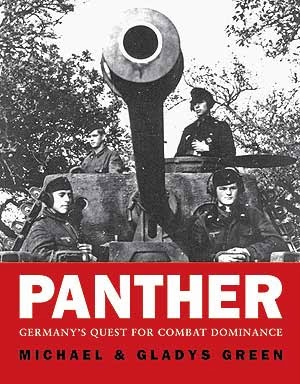
Panther: Germany's Quest for Combat Dominance 
Author/s:   Michael and Gladys Green
Publisher: Osprey [2012]
Format:    Hardback, 256 Pages
Rating:      ★★★★☆

Filled with excellent colour and period Black and White photo's the book provides a really good single volumed review of the design, development and deployment of the Panther Tank. In many ways this was a very modern medium tank and filled the roll that post war armies would define as a Main Battle Tank with all round capabilities and versatility. Despite this the Panther never fully achieved its promise, partly because it was too complicated and costly to build in wartime and partly because there were never enough of them to adequately outweigh the vast number of opposing allied tanks like the Sherman and T34. 

The book is divided into several sections which follow the usual pattern of looking at the background and development Panzerkampfwagen V Panther, its Firepower, Protection and Mobility and the many variants that also saw service. All the chapters are clearly written seem to be very well researched bringing together a wide selection of facts and statistics without ever becoming dry and boring. The book is also very well illustrated with a particularly good selection of interior photo's of a restored Panther that show the sort of details that other books often leave out. 

The RRP for this book is £25 but a quick look online shows that it is possible to find new copies at a significant discount (the normal culprits like Amazon are a good place to look) and of course you can save even more if you purchase a Kindle version. I received my copy as a gift from my Brother-in-Law who saw it and just knew I'd love it. He was right, and I thoroughly recommend this book regardless of whether you are a model maker, wargamer or vehicle enthusiast.


Rommels Desert Warriors 1941-42 (Images of War)
Author/s:   Michael Olive and Robert Edwards
Publisher: Pen and Sword Military [2012]
Format:    Hardback, 208 pages 
Rating:     ★★★★☆

This was another present, this time from my in-laws for Christmas. This book has a brief introduction and is then divided into various sections with titles such as 'Arrival in the Desert,' 'Communications,' 'Armored Vehicles,' 'Supply Battalion,' 'The Luftwaffe and Regia Aeronautica,' 'Rommel,' 'Artillery,' ' Life in the Desert' and 'Transport Vehicles.'  Each section is crammed with Black and White and Colour photos (over 300 in the book), some from official sources but most are from the private collections of ordinary soldiers. These personal photo's recorded everything from simple day to day activities and the mundanity of army life through to pictures of comrades, special occasions, cities and towns passed through and of course the desolate landscape across which they fought and died.  


Because most of the pictures come from private sources some of the captions can be a bit sparse in detail. However the authors have clearly tried to bridge the information gap with solid research and identification of vehicles, equipment and units. For the most part I think they did an excellent job and the vast majority of the pictures have good captions that help to tell the story in each of the sections in the book. There is also an eight-page 'Color of War' section which has modern colour photographs of German and Italian uniforms, helmets, weapons etc. This isn't an exhaustive reference work but it is an interesting and useful section that I think most wargamers/model painters for the period would find useful and it compliments the b&w period pictures very well. 


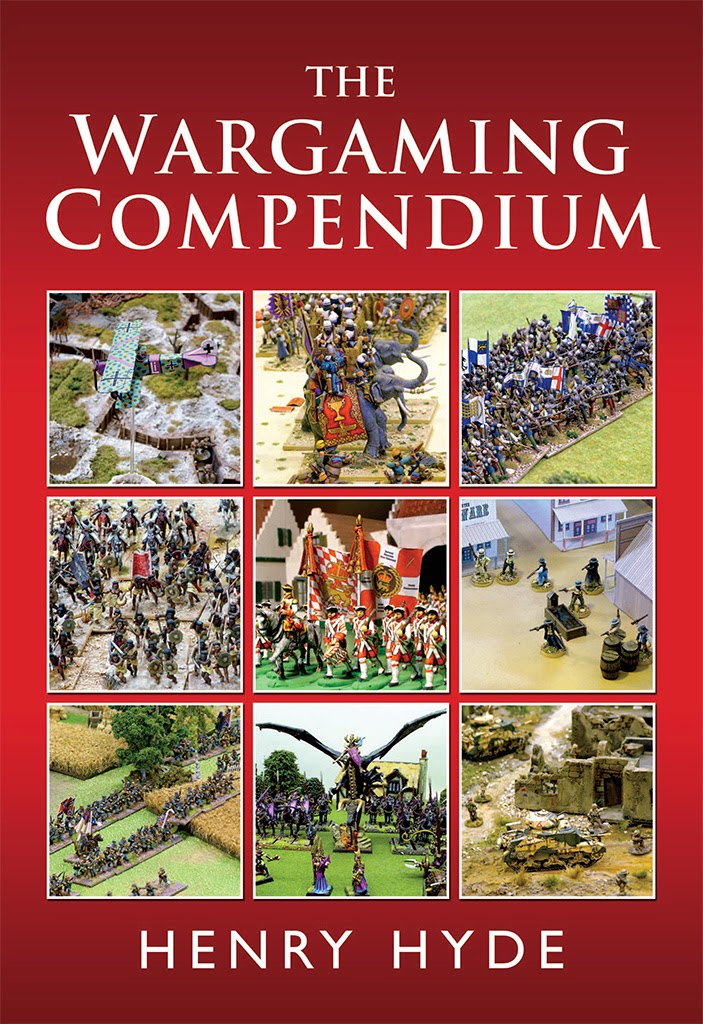
The Wargaming Compendium
Author/s:   Henry Hyde
Publisher: Pen and Sword Military [2013]
Format:    Hardback,  520 Pages
Rating:     ★★★★★


Unlike most of the books I own - which once read go into my bookshelves and rarely see the light of day again - this is the sort of book that deserves to be left out and read over and over again. I hate to describe it as a 'coffee table book' because that would trivialise the quality of the work, and this is anything but trivial. The authors long experience in the hobby both as a player and as the editor of a hugely popular wargaming magazine shines through on every page.


As well as containing a vast wealth of information on every aspect of our wonderful hobby its pages are crammed full of high quality colour photographic illustrations that make this a visual as well as an intellectual feast for the reader. For those wargamers based in the UK that regularly attend wargames shows there are plenty of photo's of popular demo games that will have you nostalgically saying "I remember seeing that!". Its for this reason (amongst others) that I think this is a great record of hobby as it is today as well as how it was in years gone by. 

Although there are sections of this compendium that are clearly aimed at new players there is also plenty within its covers that will be of interest to the old grognards amongst us. I particularly enjoyed the chapter on the history of wargaming which to my mind illustrated that our hobby is as serious and worthy a pursuit as any other, with a proud and venerated heritage. Wargaming is more than just 'playing with toy soldiers' encompassing as it does a wide range of creative endeavour and scholarly interest, proof of which can be clearly seen within the pages of this weighty volume. 

I haven't read the book cover to cover yet (it is 520 pages after all!), but I have found myself picking it up and dipping into it continually since I received it at Christmas. For me the genius of this book is that it is so readable that it doesn't matter what order you devour its many chapters, each stands out on its own merit. Henry's style of writing is very contemporary, clear and bursting with enthusiasm for his subject (something that comes across when you meet him in person as well). Young or old; newbie or old hand I think this book has something in it for every wargamer.