This is a long overdue post to expound the wonders of
Milliput putty. I've been using this stuff pretty much since I started modeling and converting miniatures way back when I was a wee lad. Let me start by makign it clear that I don't do a lot of sculpting - beyound basic items like extending hairlines or adding chainmail - but I do use this putty for gap filling and base building. In this respect I can't praise it enough for its durability and versitility.

Milliput works by mixing equal parts of the two different colour putty's together for about 4-5 minutes depending on the size your using. I tend to employ a ‘folding’ technique to avoid streaking and uneven mixing of the putty. Basically squish two balls of putty together into a flattened oblong. Then fold in half and squeeze flat again before folding again. Continue this process for a few minutes or until you have a uniform colour.
Ensure surfaces are free of dirt or grease before applying the putty. Surfaces can be cleaned with solvents or soapy water. I use a soft bristled toothbrush and washing-up liquid to wash surfaces before painting or sculpting. Most metal miniatures may still have mould release still on them or grease from handling so its a good idea to clean models before working with them even if your not using putty.
Freshly mixed
Milliput can be very sticky so I dip fingers and tools in water before handling and working with it. However you can wait and let the mix cure slightly and work with it after an hour or so when it becomes less tacky and more rubbery. This is fine for sculpting but of course you miss out on the best adhesive properties when you use part cured putty.

Always mix a little more putty than you need and keep the excess after you have finished sculpting or filling gaps. This extra piece serves as a way of testing the strength of the cure as it will set at the same rate as the material you used in your project. Once cured the beauty of this material is that it can be drilled, filed and even sanded while still retaining its adhesive properties and bonding strength.
Mixed
Milliput can be stored for up to 36 hours by freezing it. Freezing slows the curing process and means a batch of putty can be made and stored to be used over a couple of days. Officially the shelf life of
Milliput is 2 years but I have been successfully using one particular pack that I know for a fact is over 10 years old. Shelf life can be maximised by keeping the unmixed putty in airtight bags.
Lastly its worth mentioning
Greenstuff and other custom epoxy
putty's for the miniatures market. I have used various brands but always come back to M
illiput.
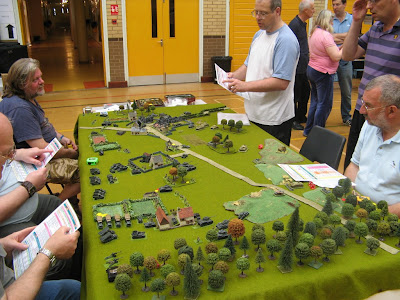
 It was good to see a 'large' battle being played out with a wide selection of miniatures representing Germans v's Russians.
 Once again everyone it was nice to meet and chat with gamers willing to interrupt their game to talk about the rules they were using.
 This was a busy table with lost going on and lots of little details that made this fun to watch and look at.


 The game took less than 10 minutes to play and the rules were pretty simple but resulted in a quick paced and exciting 'Bomb Run' towards the


 I'm off to
 I know very little about the British Army's activities outside of Europe during this period and with so little to go on these pictures remain something of an enigma and I hate a mystery. So the question is can anyone identify the regiment and maybe make an educated guess as to where he was stationed?


 One hundred and fifty years ago today

 Published to commemorate the 40th anniversary of the Normandy campaign, Panzers in Normandy is a detailed study of the German panzer regiments in 1944 as seen from the German side. The book first details the composition of the 1944 model of the panzer regiment, its equipment and personnel. The second half of the book then discusses the seventeen panzer units which saw service in Normandy. Interestingly it was research for this book which resulted in the discovery of the location of the grave of the most famous panzer commander of them all. Formerly listed as missing in action, the author of this book discovered the last resting place of the victor of Villiers-Bocage, Michael Wittmann.
 Built in the


 First off I should say that I don’t think it should be called a "Theory" - it would dignify this pseudo scientific hogwash with the trappings of legitimacy - especially as this myth is still perpetrated to this day by Internet kooks and shysters. However there was a time when the idea that the Earth had an inhabited inner world did not seem so ludicrous.
 The Hollow Earth concept is an ancient one, and for many centuries made some sort of sense as the home of Hell,


